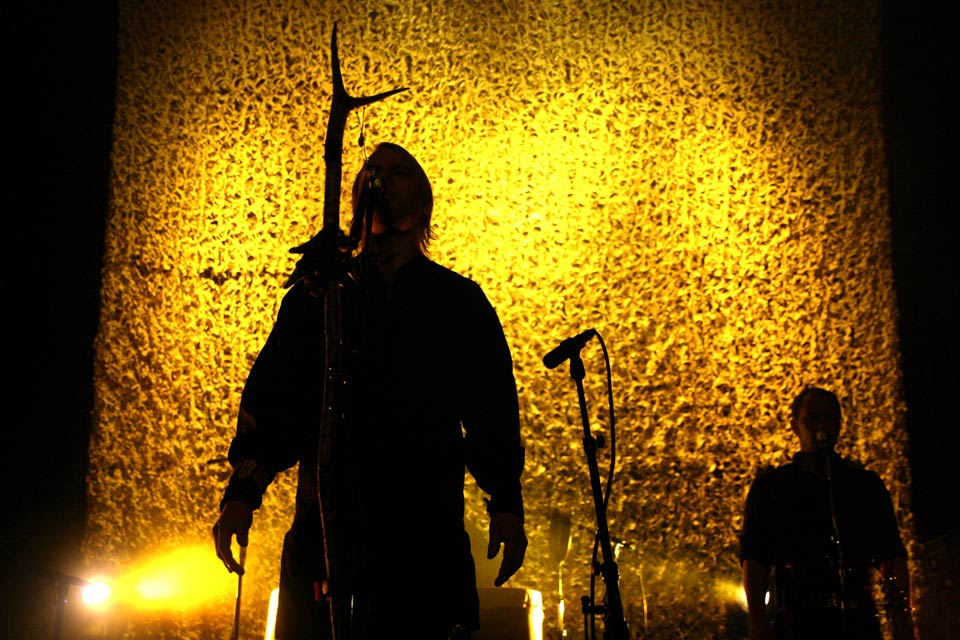
As a blog, we have focused on profiling some smaller and emerging neofolk bands in an effort to draw out the DIY elements of a grassroots scene. The perception that many have of neofolk is that all the major bands are held tightly by the far-right, examples being Blood + Sun or Death in June, but there is a whole universe of major neofolk bands who have taken a public stand against white nationalism. This is particularly true outside of the narrow English language post-punk bands that dominate much of the music press coverage. Many of the bands who drive their inspiration directly from the folk music run against this fascist interpretation, including the heathen bands of the Northern Tradition.
Wardruna is the best known of these, with their notoriety resulting from the path they have charted in taking back Nordic heritage and history from those who have attempted to racialize that history. Wardruna, which is primarily the project of musician and Nordic pagan historian Einar Selvik, has become a central figure in this trend for bringing a certain historical accuracy to portrayals of Viking Age art and music. This is what led Wardruna to the soundtrack for the History Channel show Vikings, which brought Selvik a lot of attention.
The sound itself is subcategorized as Nordic folk as it focuses heavily on heathenry, the pagan tradition that honors the Aesir and Venir and the traditions of the Nordic people’s in what is now Scandinavia. Their music drives directly from the myths and sagas, with a massive range of instrumentation that pulls from the diverse cultural span that made up the Viking Age.
When people hear terms like Nordic heritage and Viking music there is a certain unease that appears because of the way that fascists have appropriated that culture, a process that goes back almost 200 years into the early volkisch movements of 19th Century Germany. Using pseudoscienifitic and mystical ideas, they created the idea that Germanic Gods were part of the spiritual psyche of people of Germanic ethnic heritage, and that those archetypes define them as people. This rejects the actual history of heathenry, which was diverse, multiracial, and had influences from global cultural exchange.
This is a part of why Selvik has made Wardruna heavily indebted to historical accuracy and openly professes the intent of the project. White nationalism has nothing to do with the rediscovery of paganism, and uses a false modern construct to employ ancient folkways as an excuse for fascist revolution. As Selvik says:
This project takes inspiration from our native culture but it is about creating something current and new. It is also important for me to dispel a few myths about the Runes and Norse culture that have been misinterpreted and made almost cartoonish by the media.The image of the Runes has been tarnished by some right-wing racist idiots who have no business using them and only did so for their own gain.
This reconstruction of paganism is also in opposition to Christianity, seeing it as an imperialist religion that wipes away indigenous cultures through domination. This is, again, a fact that has often drawn in elements of the far-right that share an anti-Christian stance. It is also what drew in the black metal element, and something that Selvik has in common with early Wardruna member Gaahl of the early Norwegian Black Metal band Gorgoroth.
The serious focus to pagan histories, so much so that Selvik gives lectures on pagan history and sells books on heathen rituals and spirituality on the Wardruna website, is also what creates the unique multicultural understanding the band brings to the music. For Selvik, it is the diversity of pagan practice that actually unites humanity.
I’m generally interested in culture, whether it’s slavic, siberian or african. What’s fascinating, if you go back in time far enough, you’re going to see all these similarities, how we are connected. Of course, in my work, in early work with Wardruna, because the history is very fragmented, it’s only natural to look into other neighbouring cultures for inspiration and also clues.
Instead, it is allegiance to the ideas and passion for the tradition that binds a community together, not a false notion of race.
I prefer to sow seeds and let them grow, and this little weed then enters the shade of the new shoots. It is very convenient to live far from the origin of a tradition, claiming it for yourself and focusing on ethnicities rather than nature. At the same time, nature has shaped culture. I would much rather be a blót with a Spanish person who gets it than with a Norwegian who does not get it. If you are stupid, you are stupid. It does not matter if you’re descended from any Viking king.
The increased focus on Nordic history and culture, which Selvik has been a big part of, has helped to create a barrier to stop the far-right from being able to continue appropriating it without a counter-narrative.
It is a very positive effect, that increased interest does not allow the subculture on the extreme right wing to use our history in peace. We have somehow taken our own story back.
“It is difficult to take them seriously, and it testifies to great lack of knowledge when right-wing extremist groups have used our cultural heritage in their propaganda,” says Selvik, pointing out that the far-right lacks a clear understanding of Nordic paganism and instead uses it simply as an aesthetic rather than a true spiritual path.
Gaahl had been a part of the project since its founding, which many saw as problematic given that he often made up the more offensive side of black metal and was involved in far-right gangs in his youth. He has since repudiated those politics and publicly rejected them, and spoke out about what it is like to be an open gay man in the black metal scene, but we were still not comfortable with his involvement in Wardruna. In 2015 he left the band entirely and has not had any more relationship to it, a move that we support. We would not have included Wadruna if Gaahl was still in the band, and we think it is important to outline this history.
Going forward, Wardruna is continuing to be a massive project, one of Selvik’s many music endeavors, and will set the tone for much of how this more traditional sound comes together in neofolk. It is his public declarations of the intention of the music that is important because it forces the community away from an apolitical stance. While Wardruna is not political on contemporary issues, it is much more focused on songs about Thor and sailing, they use the moments they have to make it clear that they are taking a stand against the fascist creep into this cultural landscape.
We are putting a few of our favorite songs by Wardruna from their Bandcamp below, and just added a few Wardruna tracks to our Antifascist Neofolk Spotify playlist!
 A Blaze Ansuz: Antifascist Neofolk