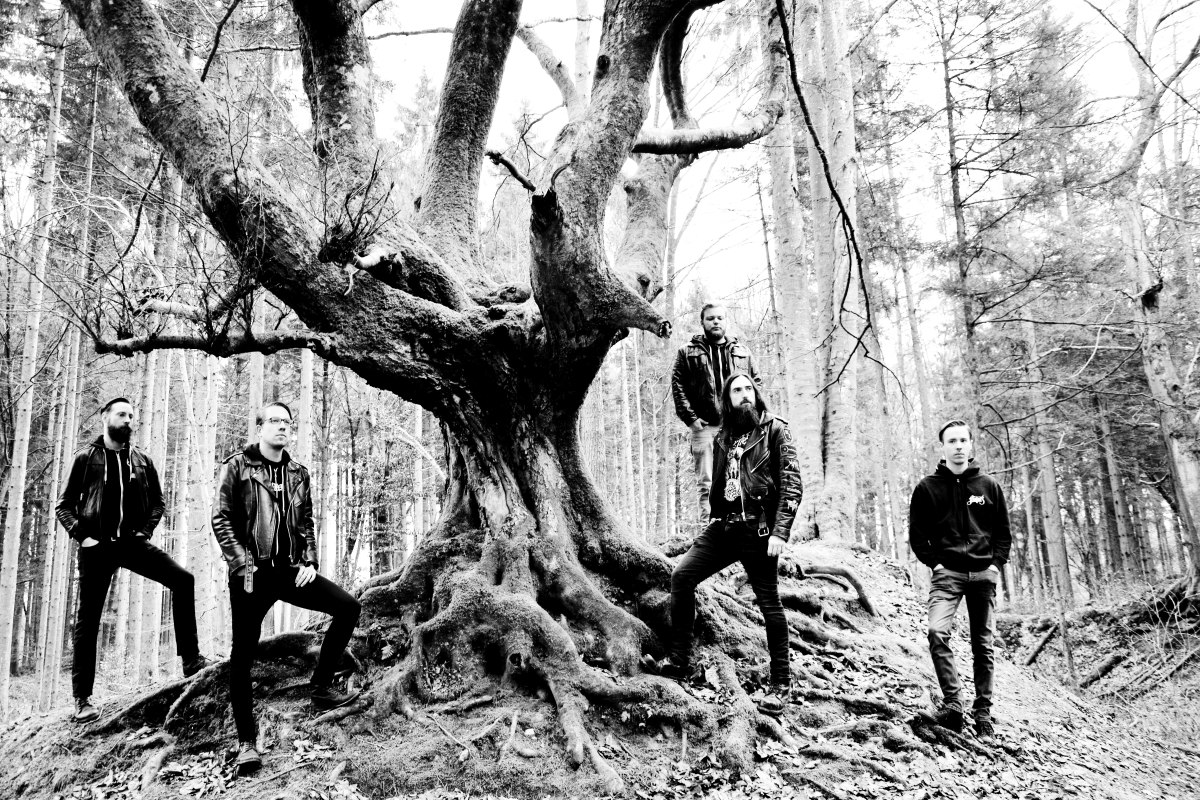
There is an epic metal quality to the Bavarian metal band Waldgeflüster, whose musical storytelling feels more like a drawn out saga rather than a radio edit. Samples, changing atmospheres, diversity is instruments and musicianship, all remind us that black metal is such a shifting currency that it can really be a platform on which to experiment. At the heart of Waldgeflüster is the use of both folk music and the forest traditions, a voice of the Gods that is much older than the songs being recorded.
We talked with the band about how they started, how they piece together their unique sound, how heathenry informs (or doesn’t) the music, and how metal can approach fascist entryism.
How did the band first come together?
I started Waldgeflüster as a Soloproject in Winter 2015. I needed an outlet for the ideas that did not fit to my main band back then. In Summer of 2006 the first demo was released, and it went on from there. I quickly recruited session musicians to play these songs I created live. I worked like this for years, with session musicians coming and going. Around 2012 the line up became more solid, and after playing with the same guys for several years and getting to know each other very good, I offered them to become full time members of Waldgeflüster, with all rights and duties that come with it. Since then we released 2 albums and 1 split, and I am still happy with the decision to ask my bandmates to join me.
Was it the first musical project you had all been in?
No. I started a band in school. Later I formed another one with some friends, which was called Scarcross. We existed for some years, recorded some stuff, played some gigs. But it never really got serious. Not because of the lack of musicianship, more due to a lack of motivation to go the extra mile by the other guys and also conflicting ideas in which direction the music should go. When this became clear to me, I started Waldgeflüster.
You have an incredibly eclectic sound, how do you define it?
We don’t define our sound. We do and create what we want to and feel like. We try to make every song unique, at least one detail must be something we never used or did before. We also get our inspiration from a lot of different genres. For example Folk, Country, Black Metal in all it’s substyles; Melodic Death and even Pop and Electronic Music can be found in my playlists. I like contrast and diversity. I guess this leads to our sound being very broad.
Do you feel like you are a part of the metal and/or neofolk scene?
I feel part of the metal scene to some extent. We define Waldgeflüster still as metal but we do not want to restrict ourselves with that label. We are very far away from the neofolk scene though; we do not have any connection points with this scene.
How does song writing take place? Is it a collaborative space?
Usually I sketch out the first ideas for a song. I record some guitar riffs and program some basic drums to them. From there it becomes a collaborative space where everyone can contribute as much as he wants. We try to keep the decisions democratic, but in the end, I have a veto right for everything I do not like. Our songs go through many iterations of demo recordings until we all agree that we have the final version, so it usually takes several months until a song is finished. We are not your classic rock band that writes some songs in a rehearsal session together, everything is done with demo recordings, that we sent back and forth.
How does heathenry inform your music? Are folk traditions important to it?
I need to be honest here: Neither heathenry nor tradition have any importance for our music. Waldgeflüster started back then with some ideas rooted in heathenry, but nowadays it doesn’t have much influence on our art. Not only would I find it to be boring after 5 albums to write about the same topic over and over again, but I also do not consider myself a heathen in a sense that most people would do. I would say I am more of a “heathen atheist” – I accept no higher power above myself, except nature. To me the Germanic mythology is an attempt to explain the forces of nature from a pre-Enlightenment perspective. It contains beautiful metaphors, and we can definitely learn from it to respect nature and worship it as our reason of being. But apart from the nature aspect, I do not take anything literal from the mythology and therefore also see no reason to be bound to any rules or ceremonies or whatever.
As for traditions: I am not a friend of traditions that are being kept alive for the tradition’s sake. Traditions were at some point born out of necessity or practical reasons. If the necessity (necessity here also includes something like the appeasing of a god) or the practical reason is lost, there is no sense in keeping them alive as an empty shell. Of course a beautiful blot has something magical about it. But if you strip it down to what is still “necessary” today – when you take away the believe in higher beings – what stays from it is the getting together with close people and for example saying a truth out loud you normally would not. To me this is the core of that specific tradition, the one thing that is still valid. What I am trying to say is this: Don’t keep traditions alive just because they are old. Take of them what is still valid and important in a modern world or even better: get rid of the old traditions and create new ones that fit to your life. In the end is not more important to create a new tradition like getting together with a close friend on regular basis than pouring some mead into the fire?
There is a heavy presence of a connectedness to nature in your sound. How does a bond with the natural world inspire your music? Is your music motivated by a sense of defense of the earth?
Nature in my music and lyrics is always present. Being out in nature inspires me. But nature is never used for its own sake. I use it to create a setting, as metaphor to talk about personal feelings and ideas. Waldgeflüster is very intimate music. It deals with my inner demons, melancholy, sadness, etc. It never preaches or deals with “wordly” stuff. At least it hasn’t so far. Nature gives me the calm and the strength to face my deepest fears and problems, that’s why the music is so connected with it. So there is no sense of defensing the earth in Waldgeflüster’s music. I deal with the world and how to make it a better place in my other project, there is no room for the everyday crisis in Waldgeflüster.
What do you think it is important to oppose fascism and racism in the music scene?
It was always important and it is becoming even more so. Throughout the whole world one can see a new rise of the right-winged, the fascist and the numb. The old argument “But I like the music” doesn’t count anymore. I will admit that I have such “guilty pleasures” with bands who at least do not distance themselves as rigid as I would like them to do so. But I will never listen or support open right-winged bands and I will defend all concerts being canceled due bands playing that are in the grey area. The funny thing is that those people who complain the most about concerts being cancelled WANT to be “dangerous” and not to be part of society, but they cry like little children when their favorite edgy band’s gig gets cancelled because they provoked just a bit too much. I find that a bit schizophrenic. So, in short, I think it is important to speak out against fascism on every occasion we get. The great majority has been quiet for too long and accepted the growth of this plague in our midst. It’s time to push back with all we have.
What bands inspire you and you would recommend for antifascist metal and neofolk fans?
I am inspired by many bands, too many in fact to mention them. If you narrow it down to bands that might be interesting to antifascist metal and neofolk fans, Panopticon is the one thing that comes to mind immediately. But I guess everyone here knows them already anyhow.
What is next for you? Any sideprojects? Do you have any tours or new releases coming out?
We are working on a release in the background, hopefully coming the beginning of next year. Don’t want to go into details yet, only that this will not be something genuinely new, but still might be of interest to people who follow us. We also plan to play some shows next year, but nothing is written in stone yet. I am also in the final steps of the production of the 2nd album of Uprising. Uprising is my side project where I focus on more traditional Black Metal but with a very “wordly” and leftist agenda.
We added a Waldgeflüster track to the Antifascist Neofolk Playlist on Spotify, as well as a number of other new additions to the playlist. Make sure to add it and share it around. Also check out some of their albums from their Bandcamp.
 A Blaze Ansuz: Antifascist Neofolk