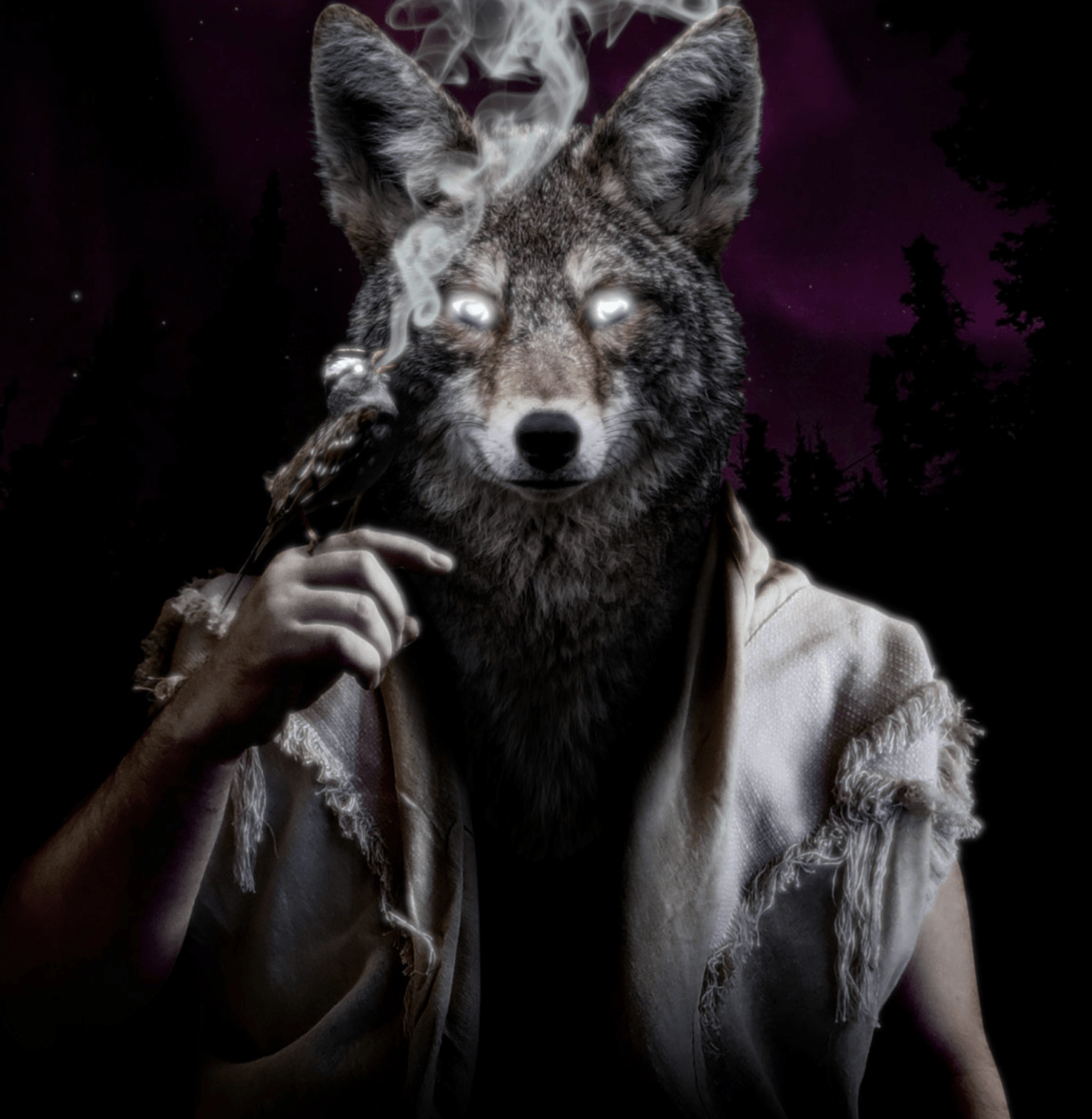
There is an aura around the American neofolk band Nøkken + The Grim. The cry of thunder, the animal shuffle through the trees, the underlying soundtrack of the forest. Nøkken + The Grim is an open attempt to capture that, to rewild ourselves and to expand our view of community to the animals and the earth. This spirit of resistance is alive in their animism, and it is what makes Nøkken + The Grim such an incredibly evocative ensemble, emotive in every quiet moment.
We interviewed Justin Gortva Scheibel, who acted as a spokesperson for the band, about exactly what drives his project, what the music means to him, and why we have to be public antifascists today.
How did your band come together?
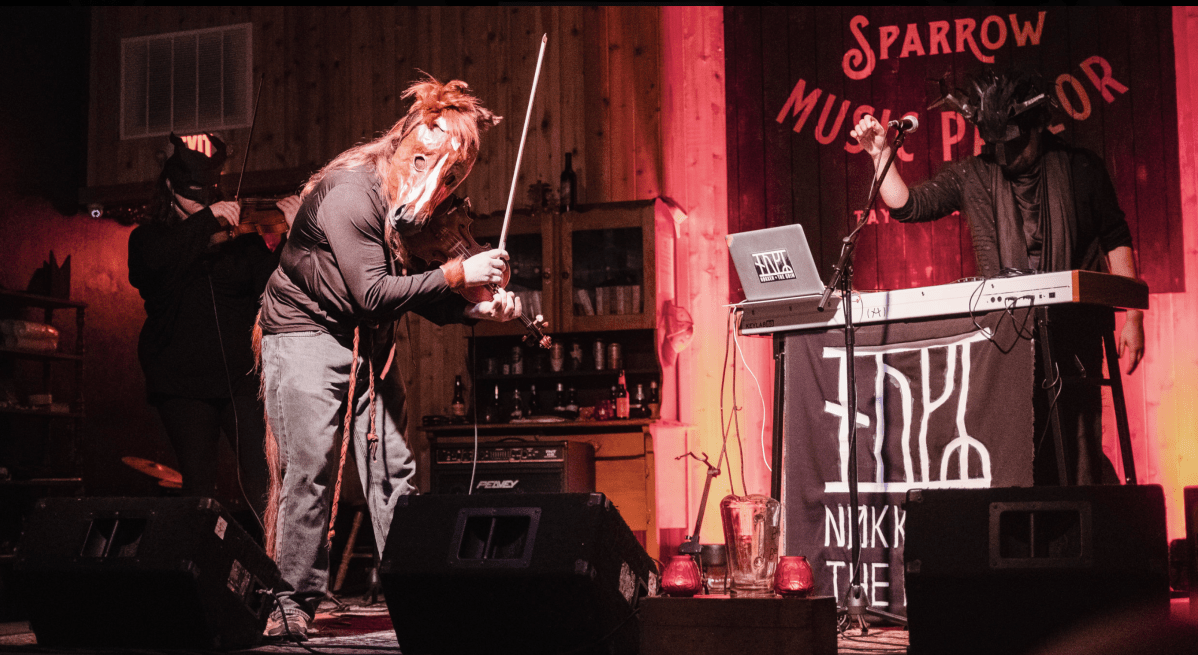
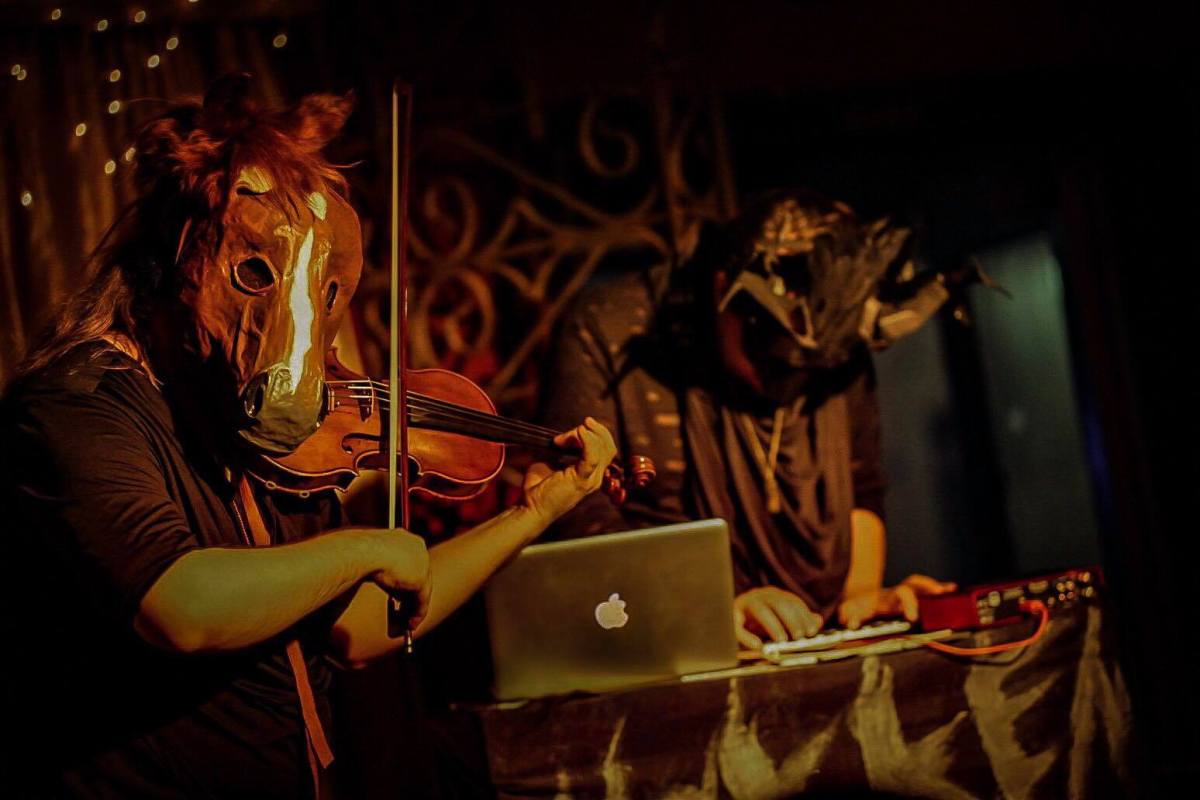
The original seed for this was planted back in 2015. The band started as a solo project called Nøkken. I performed in a cheap, plastic horse mask, something like a scavenger using humanity’s discard. Stephen and I have been in a relationship since 2011, and I’ve known Karli for as long. We all lived together, working as musicians, so it made sense for us to start performing. There was a narrative forming on two levels. I was already performing as a nature spirit, and it was as if that had attracted other spirits out of the woodwork. So, we expanded the idea, and they became “The Grim,” other enraged nature spirits who have rallied against the desecration of nature and their homes. Each month brought about subtle growth, new conflicts, new possibilities, but, like watching a plant grow, there is no single “event” where it formed. It organically evolved into what it is now.
How does paganism and animism provide inspiration for the music? Do you think the music itself is a ritual space?
Something that is often unexplored in music is the primality of expressions prior the violence that language and words inflict upon the world, cutting and dividing things into categories. People often want lyrics. They want things to “make sense.” They demand it of the world. But I want wild cries of animals led by instinct from one note to another, where human conventions of music and meaning no longer matter. It is why we focus on improvisation, on being animals speaking through music. Animism recognizes an interconnectedness of all things, and the presence of other-than-human spirits in everything. We see this in our music, and we join with the ways in which each animate being produces music as a form of primal communication. The Earth Mother moves in cycles, large and small, from the replication of cells to massive shifts in climate and tectonic movements. Right now, humanity is messing with cycles of life and causing global extinctions. It is an interruption of rhythm, as much as a musician who slips and misses a beat, except with dire consequences for all life. Our music is a miniature of all this rhythm, both the cycles and the cataclysmic destruction of these cycles, where we no longer distinguish our rhythms from the processes of life and death.
From a more personal perspective, I serve the Earth Mother, and I am an extension of the primal spirit of the horse. Modern thought would probably call me an “animal worshipper” with a bit of a sneer. I am ethnically Hungarian and German. My heritage in Magyar táltos tradition (‘shamanism’) and Norse heathenry serve as the folk roots of the characters we play on stage. For me, this music is deeply spiritual. Stephen and Karli, who join me are not pagan, but are an agnostic and a Christian deist respectively. What unifies us is our recognition that human oppression towards each other and the living world cannot be tolerated, that human beings cannot continue to destroy nature.
I think music in general is a powerful ritual space, and not enough people recognize the responsibility that musicians have. Music is a vehicle of attention, synchrony and transformation, a place where many different wills coincide. With all that intention collected in a single space, magic flows through our sensuous bodies and can be channeled, for better or for worse. I perform all my concerts in a trance state in which the illusions of being human have disappeared. I feel like there is no break between the stage and the audience. We become coils of ritualized rhythm.
What bands inspired you in doing the work?
It’s a strange mixture of things. I love the alienated beauty of Buckethead’s guitar playing. He originally inspired me to put on a mask. The integrity of Moddi and Tanya Tagaq are also sources of inspiration. The Hungarian composer Béla Bartók has been a huge influence in our thought and harmonies. He was one of the first ethnomusicologists documenting folk music traditions, but he also wrote his own strange contemporary versions of folk music. Bartók was an anti-fascist who sacrificed his music career in Hungary in protest. He eventually fled to the United States. Over the years, we’ve been influenced a lot by bands like Tengger Cavalry, Ulver, Garmarna and Heilung. Karli is huge into Neue Deutsche Härte, folk metal, basically anything from Scandinavia and Germany. Stephen, as a composer, also brings a ton of influences from film music, EDM, jazz and ambient into our sound. He and I work together to create the electronic soundscapes that permeate our music. Probably our most out-there influence is John Cage.
There is a beautifully quiet quality to your music, both haunting and curious. How did you start to develop the uniqueness of your sound? How do you define it?
We started out performing music that fit more into neoclassical styles, as classically trained musicians. We did improvisation and performed works by minimalist and modern composers, and then we thought, “fuck it, we could do whatever the hell we want with music.” I suppose I would call our music “uncivilized,” or perhaps, “undomesticated” music, “wild,” “bestial”. There is no guarantee that we will ever sound the same from one moment to another.
“Primal” is probably my favorite word to describe what we do, if there is to be a word. It is instinctual music, to create music in terms of our senses and emotions, our animal being. We lose the idea that there is ever a wrong or right note—just different notes in sensuous immediacy. Conventional music adheres to a pattern it justifies to itself, so it forms into a genre, a style, a normative imposition on what music “should be.” Musical conventions very easily slip into oppressive institutions. You see this all the time with people talking about how they hate this music or that music. Primal music may form patterns (just as the growth of nature forms chaotic patterns, sometimes tremendously complex), but they are not dictated by forethought, imposition, the tyranny of order, only chance and instinct, necessity and intuition. We are aware of many “musical rules” but simply do not care. Human conventions pretend to themselves they are not profoundly instinctual, irrational and accidental. So perhaps, primal music is music without this pretense. It has gone feral.
Our song “Blue Ritual” is a great example. Everything about it is “wrong,” strange meters, harmonies, off-kilter patterns of 7, live outdoor recordings mixed with studio electronics. It is like a weed that decides to grow in one’s perfectly manicured lawn, Mother Nature’s green middle finger to the need for control and order. I like weeds. I am happy to be a weed.
Why have you included actual sounds from nature, like rumbling thunderstorms, in the music?
We put thunderstorms in “Vox Terrae” to evoke nature in sublime way and to give the music connectedness with the living world. “Vox Terrae” means “Voice of the Earth,” the Earth as a singer. It’s this recognition that sound and nature have their own agency; I would say intention. There are many agents beyond the mere human, other species, animals, plants, microbes. Also, whole natural phenomena are recognized as part of this animate, living ecosystem. Human beings tend to try to differentiate between “music” and “sound” and operate under a pretense that “sound” occurs without agency, while “music” is this supposedly willed (exclusively human) thing. It’s all part of this colonialist objectification of the world. But all animals are producing music, the songs of birds, the rhythms of horses’ bodies. Moreover, everything that happens is rhythm. So-called ‘chance’ sounds, natural phenomena, are as much music as anything human beings produce. I see the world of sound as a world filled to the brim with agency, spirits, actors, where nature speaks and sings in all moments of resonance. Sound is itself a living environment, one in which a multitude of agencies are acting. For me, it is not strange at all to see a storm as a musician, a person, collaborating to produce music. Or moreso, we are invited by the Earth as collaborators, lent this moment of time to be alive.
There is a huge variety, it moves from frenetic synth inspired tracks to very slow and plotting melancholy sound, do you feel like you are constantly reinventing your sound?
Personally, I would prefer to just to exist without having to have “a sound.” That is, I would like, in music, to follow every instinctual urge I have, whether that is violent, sensitive, sexual, explosive, playful. To the person listening, I think it probably sounds like we are constantly reinventing our sound, but to me, we are shapeshifters by nature. If I need to be violent in a song, then that is what happens. If I need to whisper, or yell, or seduce…our bodies produce the music. The concept of having a static sound is exactly what institutions impose upon our animal bodies, and those categories only serve to reinforce hierarchies in world.
What drives your commitment to antifascism? Have you experienced a lot of white supremacist attitudes in the pagan and neofolk scene?
I would say that I have run into explicit white supremacists rather infrequently. The real fear lies in the undercurrents of racism and authoritarianism in ‘ordinary’ people whom supremacists are trying to win over. I feel that both the Pagan and neofolk scenes are very anti-fascist already and that the situation is not as bleak. All the Heathen and Pagan communities I partake in online and offline are working ceaselessly against supremacists. There is a recognition in much of the Pagan and Heathen communities that our own cultures and beliefs were colonized by Christian theo-political violence and oppression (and continue to be demonized to this day), and this unites us with the struggles of all other oppressed minorities. But there is fear across the Pagan communities to even talk about what we are doing. We are still afraid of being persecuted by mainstream religions as “devil worshippers.”
Within me, there is a deeper, personal anger at the fact that the Nazis appropriated our spiritual symbols and concepts. It was festering rot, feasting on the corpse of indigenous European traditions, appropriating our symbols and our heritage for their purpose of hate. It wasn’t enough that my cultural heritage was decimated by religious persecution throughout European history, especially my spirituality, which was thoroughly destroyed by Christianity. Our symbols then became corrupted and mutilated by honorless Nazi thugs who worshipped nothing but their own pettiness, driving them to hatred.
My love for all difference and my fury against injustice runs deeper than words or reason. Spiritually, I seek liberation of the natural world and other-than-human life, and I extend that to the struggles of all different human peoples. You could say it is in my blood to be anti-fascist, to be a freedom fighter. My family escaped from Hungary as refugees and came to the United States seeking asylum. Members of my family fought in the Hungarian underground resistance. My existence could never have been if they resist oppression and leave their homeland.
Why do you think it is important to be a publicly antifascist band? How does antifascism inform your music?
I think people are getting complacent with hate. Silence is the real problem. Artists must be willing to stand up and show others that they are not alone. I also think that some music groups wait too long to disclose their stances on important subjects like this for fear that it will limit their audience. I don’t know about them, but we don’t want fascists and white supremacists in our audience. They can fuck right off.
Anti-fascism informs our music in loving and seeing beauty in difference and in the necessity to do what we can as artists against hatred. We see our music as undermining the colonization of the world—singing against the destruction of wildlands, the erasure of indigenous beliefs and peoples, against voracious and spiritually empty consumerism and authoritarianism.
What kind struggles drive your work? There is a strong sense of a need to a return to a cyclical, grounded way of life in communities.
I agree. To add to that, our music expresses this need to recognize the entire world of other-than-human life as part of that community. A few concepts that are important to us are the idea of “re-wilding,” David Abram’s notion of “becoming animal” and what the ecofeminist philosopher Donna Haraway calls “kin-making” and “companion species.” I see modern society as having this ill ideology of trying to leave behind nature and animal being, of trying to transcend themselves, of trying to domesticate and dominate everything, warring with their own natures, consuming the world to feed industry and Ego eating itself. Humans fail to even recognize that other animals have forms of intelligence and cognition that exceed their own, something that is fortunately being corrected by the scientific field of cognitive ethology. Traditions and spiritualities that celebrate being kin with the world, with animal life—of being part of an ecosystem instead of holding dominion over it—end up as victims of modernization. This is especially true for indigenous peoples who are deprived of the natural cycles and resources needed to sustain their life-ways. I see our music as embracing and conjuring our own animality to rejoin with our other-than-human animal brothers and sisters, to relearn how to live alongside the more-than-human world instead of enslaving and destroying it.
What’s coming next for you?
We currently have two major projects in the works. We just finished shooting for a short film/music video for our song “Vox Terrae,” and we mastered a live performance of the track to release as a single alongside the video. We are also working on writing and recording our next album. (Well, really it is two albums to be released side-by-side. The concept behind them is kind of insane. Can’t say more than that, yet.)
What other bands do you recommend for antifascist neofolk fans?
Ulvesang, Hanggai, Tengger Cavalry, Garmarna, Heilung, Wardruna, Soriah, Tanya Tagaq, Paleowolf, Forndom, Jambinai, Bohemian Betyars. Julius Eastman is an unsung hero whose entire life’s work as a composer was dedicated to fighting racism and homophobia. He was a queer black performer, and today his work should probably come with a trigger warning because his song titles often included the racial slurs that were being thrown at him during his life. Part of it was he wanted the classical music community to look their own racism in the face every time his music was performed.
Moddi has been a longtime favorite of the whole band, a folk singer from Norway who melds haunting melodies with political activism. His album “Unsongs” is a must for anti-fascist artists and activists. The album is entirely made of songs banned by oppressive regimes. There are also documentaries about each song and its historic context on YouTube.
Below we are putting tracks from the latest album, Trickster God, as well as the most recent album before that, Treason to Our Nature. We have also added tracks from Treason to Our Nature to the Antifascist Neofolk playlist on Spotify.
 A Blaze Ansuz: Antifascist Neofolk